Translate

Showing posts with label children's poetry. Show all posts

Thursday, November 21, 2013

'Twas Brillig---Es Brillig War


Jabberwocky 


'Twas brillig, and the slithy toves 
    Did gyre and gimble in the wabe; 
All mimsy were the borogoves, 
    And the mome raths outgrabe.


"Beware the Jabberwock, my son! 
    The jaws that bite, the claws that catch! 
Beware the Jubjub bird, and shun 
    The frumious Bandersnatch!"

He took his vorpal sword in hand: 
    Long time the manxome foe he sought -- 
So rested he by the Tumtum tree. 
    And stood awhile in thought.

And as in uffish thought he stood, 
    The Jabberwock, with eyes of flame, 
Came wiffling through the tulgey wood, 
    And burbled as it came!

One, two! One, two! And through and through 
    The vorpal blade went snicker-snack! 
He left it dead, and with its head 
    He went galumphing back.

"And hast thou slain the Jabberwock? 
    Come to my arms, my beamish boy! 
O frabjous day! Callooh! Callay!" 
    He chortled in his joy.

'Twas brillig, and the slithy toves 
    Did gyre and gimble in the wabe; 
All mimsy were the borogoves, 
    And the mome raths outgrabe.


                                           Lewis Carroll


Der Jammerwoch


Es brillig war. Die schlichte Toven
Wirrten und wimmelten in Waben;
Und aller-mümsige Burggoven
Die mohmen Räth' ausgraben.

»Bewahre doch vor Jammerwoch!
Die Zähne knirschen, Krallen kratzen!
Bewahr' vor Jubjub-Vogel, vor
Frumiösen Banderschntzchen!«

Er griff sein vorpals Schwertchen zu,
Er suchte lang das manchsan' Ding;
Dann, stehend unterm Tumtum Baum,
Er an-zu-denken-fing.

Als stand er tief in Andacht auf,
Des Jammerwochen's Augen-feuer
Durch tulgen Wald mit Wiffek kam
Ein burbelnd Ungeheuer!

Eins, Zwei! Eins, Zwei! Und durch und durch
Sein vorpals Schwert zerschnifer-schnück,
Da blieb es todt! Er, Kopf in Hand,
Geläumfig zog zurück.

»Und schlugst Du ja den Jammerwoch?
Umarme mich, mien Böhm'sches Kind!
O Freuden-Tag! O Halloo-Schlag!«
Er schortelt froh-gesinnt.

Es brillig war. Die schlichte Toven
Wirrten und wimmelten in Waben;
Und aller-mümsige Burggoven
Die mohmen Räth' ausgraben.


                                     Robert Scott


Scott, Robert. "The Jabberwock Traced to Its True Source", MacMillan's Magazine, Feb 1872. This article was a clever conceit written by a friend of Rev. Dodgson pretending to uncover the true genesis of the famous poem in an ancient German verse. The word sounds of this German version are truly ausgezeichnet!

Jabberwocky, by Lewis Carroll, from Through the Looking Glass and What Alice Found There, 1872
The illustration included above is by John Tenniel and is from that same volume.


Thursday, November 14, 2013

HOLiDAY TiDiNGS, O CHRISTMAS TREE, from "Christmas Poems" and the Gospel of Matthew


Christmas Poems
Selected by Myra Cohn Livingston
Illustrated by Trina Schart Hyman


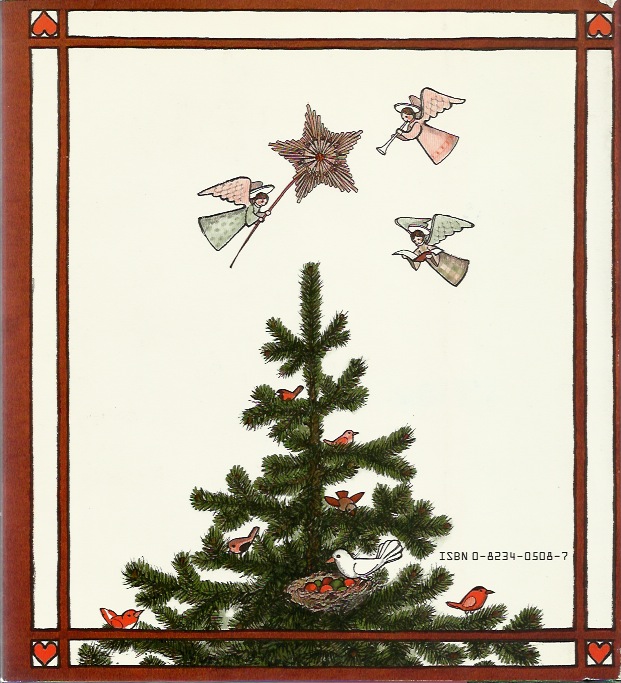
Christmas Poems, back cover


As a young child I loved the Christmas holiday and especially the Christmas tree.  I enjoyed decorating it with all our family ornaments and then I would spend hours with my little sister playing pretend games with the ornaments, rearranging them, and telling the stories and legends that were part of the season's tradition.  Every few days, my sister and I would also have to rearrange the gifts that collected under the tree.  But, for me, the tree itself was the main event at Christmastime.

I tell you this here because of the enchanting illustrations that Trina created for this volume of Christmas poetry.  They capture that same playful reverence for the objects and spirit of the season---the tree, the ornaments, the symbols, the wonder of the baby Jesus in a manger. Trina gets right down into the tree and plays with it in these pictures, just as I remember doing those many years ago.


Here then are a few excerpts from this wonderful book of verse, as well as some other holiday literature, to help bring in the magic of this beautiful season.


                                                Merry Christmas, 2013
                                                              from Leon Archibald


from Christmas Morning


Christmas bells, awake and ring
Your carol of long ago,
Awake O wintry sun and fling
Your beams across the snow!


                                 Harry Behn


Christmas Is Coming


Christmas is coming, the geese are getting fat,
Please to put a penny in an old man's hat;
If you haven't got a penny, a ha'penny will do,
If you haven't got a ha'penny, God bless you.


                                  Traditional, English


There Came Wise Men from the East


Now when Jesus was born in Bethlehem of Judaea
in the days of Herod the king,
behold, there came wise men from the east to Jerusalem,

Saying,
Where is he that is born King of the Jews?
for we have seen his star in the east,
and are come to worship him.

And, lo,
the star, which they saw in the east,
went before them,
till it came and stood over where the young child was.

When they saw the star, 
they rejoiced with exceeding great joy,

And when they were come into the house,
they saw the young child with Mary his mother,
and fell down, and worshipped him;
and when they had opened their treasures,
they presented unto him gifts;
gold, and frankincense, and myrrh.


                              Matthew 2: 1-2, 9-11   The Bible, King James Version


from Christmas Prayer
(To be read very slowly out loud)


But let peace, though it fade by the minute,
Be in it--this room where we are;
Let the Saint from his chimney assemble
The symbols of tree, of bright star;

Of Christmas at dawn in a stocking,
Unlocking remembered delight
As it was.  Praise Him, born in a stable,
At table: praise God.  Bless this night.


                                           David McCord


from Kaleidoscope


Sheep and ox guard manger
       Magi offer gifts.
            Down through white
            silent night
                   slow
                   snow

                                        sifts.


                                                      X. J. Kennedy


O Christmas Tree

O Christmas Tree, O Christmas tree,
How lovely are thy branches!
O Christmas Tree, O Christmas tree,
How lovely are thy branches!
Through summer sun and winter snow
In beauty green will always grow.
O Christmas tree, O Christmas tree,
How lovely are thy branches!


O Christmas tree, O Christmas tree,
Thy candles shine out brightly!
O Christmas tree, O Christmas tree,
Thy candles shine out brightly!
Each bough doth hold its tiny light,
That makes each toy to sparkle bright.
O Christmas tree, O Christmas tree,
Thy candles shine out brightly!


O Christmas tree, O Christmas tree!
Thou tree most fair and lovely!
O Christmas tree, O Christmas tree!
Thou tree most fair and lovely!
Thou dost proclaim the Savior’s birth,
Good will to men and peace on earth.
O Christmas tree, O Christmas tree!
Thou tree most fair and lovely.


O Tannenbaum. First verse is traditional German, and sometimes attributed to August Zarnack, 1820; second verse by Ernst Gebhard Anschutz, 1824; other verse: unknown. Verse selection and arrangement by L.A.


Trina Schart Hyman


Trina Schart Hyman was awarded the Caldecott Medal in 1985 for her illustrations in Saint George and the Dragon retold by Margaret Hodges. Her edition of Little Red Riding Hood --which had always been one of her favorite stories--was one of the 1984 Caldecott Honor Books. Trina passed away in November of 2004 after a long battle with cancer.  

I had invited Trina to illustrate a collection of Christmas tales to be publish by Little Simon in the mid-80s; but I moved to Putnam Young Readers Group and began working in publicity, so, unfortunately, the project did not go forward.


Myra Cohn Livingston was the recipient of the 1980 Excellence in Poetry Award from the National Council of Teachers of English. She has received critical acclaim for her poetry and her many anthologies. Myra Cohn Livingston was born in Omaha, Nebraska in 1926, and lived in Texas and California. For over twenty years she taught at the University of California at Los Angeles. She was living in Beverly Hills, CA when she passed away in 1996.


Except for the biblical quote and the carol, all of these poems and poetic excerpts appeared in Christmas Poems, Holiday House, New York, 1984. "Kaleidoscope," and "Christmas Prayer" were specially commissioned for the book.

Christmas Poems is out of print.  My favorite source for used books online is Better World Books


_________________________________________
Here are more holiday tomes, and a poster, with illustrations by Trina Schart Hyman:


Limited edition poster with illustrations from the book-- for info go to www.booksofwondershop.com


And one more for Hanukkah!


_____________
HOLiDAY TiDiNGS is a continuing series of articles for this blog that will focus on poetry and other literature written for or appropriate to a specific holiday.

Tuesday, November 12, 2013

HOLiDAY TiDiNGS from "Poems for Jewish Holidays" and other sources


Yom Kippur

For It Is a Day of Atonement

And HaShem spoke unto Moses, saying:
Howbeit on the tenth day of this seventh month is the day of atonement; 
there shall be an holy convocation unto you, 
and ye shall afflict your souls; 
and ye shall bring an offering made by fire unto HaShem.

And ye shall do no manner of work in that same day; 
for it is a day of atonement, 
to make atonement for you before HaShem your G-d.

                                        from the Book of Vayikra (Leviticus)


HaShem means "The Name" in Hebrew and is used in Jewish scripture to avoid the use of the name of deity.


from HOW TO GET THROUGH THE MEMORIAL SERVICE


If restless, let little words
come to your aid:
drop an "e" into "fast"
and enjoy the sudden feast.
Double the "o" in God.
That's good.


               Richard J. Margolis, 1929-1991


Purim


from THE FOURTEENTH DAY OF ADAR

Tonight
in my long dress I will be
Esther the Queen.
Tonight
on a small stage I will save
my people.  I will remember
my lines.

"There he crawls!"  I will say
to the King.
"There he crawls--in his 
three-cornered hat--the serpent, Haman!"


                Barbara Juster Esbensen, 1925-1996


HAMAN AND ESTHER, THE QUEEN

Haman, the enemy of all the Jews, had devised against the Jews to destroy them, and had cast pur, that is, the lot, to discomfit them, and to destroy them; but when Esther came before the king, he commanded by letters that Haman’s wicked device, which he had devised against the Jews, should return upon his own head; and that he and his sons should be hanged on the gallows.

Wherefore they called these days Purim, after the name of pur.  And the Jews ordained, and took upon them, so as it should not fail, that they would keep these two days according to the appointed time every year.


Therefore do the Jews of the villages, that dwell in the unwalled towns, make the fourteenth day of the month Adar a day of gladness and feasting, and a good day, and of sending portions one to another.


                                                  Book of Esther, Chapter 9


Chanukah


A century after the conquest of the Middle East by Alexander the Great, one of his generals, Antiochus IV, was in control of the region.  He began to oppress the Jews severely, placing Hellenistic priests in the Temple, massacring Jews, prohibiting the practice of the Jewish religion, and desecrating the Temple by requiring the sacrifice of non-kosher animals on the altar. Two groups opposed Antiochus: a nationalistic group led by Mattathias, the Hasmonean, and his son Judah Maccabee, and a religious group known as the Chasidim, the forerunners of the Pharisees. The revolution succeeded and the Temple was rededicated.

According to tradition as recorded in the Talmud, at the time of the rededication, there was very little oil left at the Temple that had not been defiled by the Greeks.  Oil was needed for the menorah (candelabrum), which was supposed to burn throughout the night every night. There was only enough oil to burn for one day, yet miraculously, it burned for eight days.  An eight-day festival was declared to commemorate this miracle. Note that the holiday commemorates the miracle of the oil, not the military victory.

Chanukah is not mentioned in Jewish scripture; the story is related in the book of the Maccabbees, which Jews do not accept as scripture.

The only religious observance related to the holiday is the lighting of candles. The candles are arranged in a candelabrum called a Hanukia. Many people refer to the Hanukia incorrectly as a menorah. The name menorah is used only to describe the seven-branched candelabrum that was housed in the Jewish Temple. The Hanukia holds nine candles: one for each night, plus a shamash, or servant, which is set at a different height from the other candles and is used to light them. 


Passover


I Will Bring You Out


And HaShem said unto Moses: 
Wherefore say unto the children of Israel: 
I am HaShem, 
and I will bring you out from under the burdens of the Egyptians, 
and I will deliver you from their bondage, 
and I will redeem you with an outstretched arm, 
and with great judgments;
and I will take you to Me for a people, 
and I will be to you a G-d; 
and ye shall know that I am HaShem your G-d, 
who brought you out from under the burdens of the Egyptians.
And I will bring you in unto the land, 
concerning which I lifted up My hand 
to give it to Abraham, to Isaac, and to Jacob; 
and I will give it you for an heritage: 
I am HaShem.

                                               from The Book of Shemot (Exodus)


HaShem means "The Name" in Hebrew and is used in Jewish scripture to avoid the use of the name of deity.


THIS IS THE BREAD OF AFFLICTION


This is the bread of affliction 
that our fathers ate in the land of Egypt. 
Whoever is hungry, 
let him come and eat; 
whoever is in need, 
let him come....

This year we are here; 

next year in the land of Israel. 
This year we are slaves; 
next year we will be free....

                                            from the Haggadah


YOU HAVE REDEEMED US FROM EGYPT


You have redeemed us from Egypt, 
You have freed us from the house of bondage, 
You have fed us in famine and nourished us in plenty; 
You have saved us from the sword and delivered us from pestilence, 
and raised us from evil and lasting maladies. 
Until now Your mercies have helped us, 
and Your kindnesses have not forsaken us; 
and do not abandon us, L-rd our G-d, forever!

                                             from the Haggadah


An Only Kid (Had Gadya)


An only kid! An only kid!
My father bought for two zuzim had gadya.

Then came the cat
And ate the kid
My father bought for two zuzim had gadya.

Then came the dog
And bit the cat
That ate the kid
My father bought for two zuzim had gadya.

Then came the stick
And beat the dog
That bit the cat
That ate the kid
My father bought for two zuzim had gadya.

Then came the fire
And burned the stick 
That beat the dog
That bit the cat
That ate the kid
My father bought for two zuzim had gadya.

Then came the water
And quenched the fire
That burned the stick
That beat the dog
That bit the cat
That ate the kid
My father bought for two zuzim had gadya.

Then came the ox
And drank the water
That quenched the fire
That burned the stick
That beat the dog
That bit the cat
That ate the kid
My father bought for two zuzim had gadya.

Then came the butcher
And killed the ox
That drank the water
That quenched the fire
That burned the stick
That beat the dog
That bit the cat
That ate the kid
My father bought for two zuzim had gadya.

Then came the angel of death
And slew the butcher
That killed the ox
That drank the water
That quenched the fire
That burned the stick
That beat the dog
That bit the cat
That ate the kid
My father bought for two zuzim had gadya.

Then came the Holy One, blessed be He,
And destroyed the angel of death
That slew the butcher
That killed the ox
That drank the water
That quenched the fire
That burned the stick
That beat the dog
That bit the cat
That ate the kid
My father bought for two zuzim had gadya.


                                 Traditional Jewish folk song

Zuzim  is the plural form of zuz---an ancient Hebrew silver coin.

Had gadya means "one little goat" or, as in this old song, "an only kid"


___________________________________________________________


Myra Cohn Livingston was the recipient of the 1980 Excellence in Poetry Award from the National Council of Teachers of English. She has received critical acclaim for her poetry and her many anthologies. Myra Cohn Livingston was born in Omaha, Nebraska in 1926, and lived in Texas and California. For over twenty years she taught at the University of California at Los Angeles. She was living in Beverly Hills, California when she passed away in 1996.


Lloyd Bloom

In 1987 Lloyd Bloom won the National Jewish Book Council Award for Illustration for the book featured here, Poems for Jewish Holidays. He has also illustrated Like Jake and Me, by Mavis Jukes, and A Man Named Thoreau by Robert Burleigh, which was a Boston Globe-Horn Book honor book for illustration. He lives in Brooklyn, New York.


__________________________________________________________

The excerpts from HOW TO GET THROUGH THE MEMORIAL SERVICE by Richard J. Margolis, and THE FOURTEENTH DAY OF ADAR by Barbara Juster Esbensen, as well as the folksong AN ONLY KID are from Poems for Jewish Holidays, Holiday House, NY, 1986.  

This title is out of print.  A good source for used books is Better World Books online:
Better World Books

___________________
Sources for the other material included as follows:

Leviticus 23:26-28, Exodus 6:6-8 and Esther 9 (paraphrased) from The Tanakh (Jewish Bible), and "Jewish Holidays: Chanukah"(adapted)-- American-Israeli Cooperative Enterprise, 2013, their link is:
Jewish Virtual Library Bible  

The excerpts from the Passover Seder are from an English Haggadah, Chabad-Lubavitch Media Center, 2013, their link is: Chabad Haggadah


____________________
HOLiDAY TiDiNGS is a continuing series of articles for this blog that focus on poetry and other literature written for or appropriate to  specific holidays.